United States Bureau of Impossible PatentsБюро невозможных патентов СШАBureau américain des brevets impossibles
Faster-than-Light CommunicatorСверхсветовой коммуникаторFaster-than-Light Communicator
Patent № US-IMP-3,887,???Патент № US-IMP-3,887,???Patent № US-IMP-3,887,???
- Caveat
- ORCON · NOFORN · REL TO BUREAU PERSONNEL · NO COPY
- Compartment
- TALON/DROWN
- Distribution
- ██ copies authorized · all numbered · all logged
- Declassify on
- ██████████ + 50 Y from filing date
- Access log entry
- Folio #68299 · accessed by ████████ · 26-██-████
- Warning
- This document contains national-defense information. Mishandling subject to criminal sanctions under 18 U.S.C. §§ 793, 794.
- Гриф
- С согласия источника · Без передачи иностранцам · Не копировать
- Отделение
- КОГОТЬ/УТОПЛЕНИЕ
- Распространение
- ██ разрешённых копий · все номерные · все журналируются
- Срок рассекречивания
- ██████████ + 50 лет от даты подачи
- Запись в журнале
- Том №68299 · выдан ████████ · 26-██-████
- Внимание
- Документ содержит сведения, составляющие государственную тайну. Нарушение режима преследуется по закону.
- Caveat
- ORCON · NOFORN · REL TO BUREAU PERSONNEL · NO COPY
- Compartment
- TALON/DROWN
- Distribution
- ██ copies authorized · all numbered · all logged
- Declassify on
- ██████████ + 50 Y from filing date
- Access log entry
- Folio #68299 · accessed by ████████ · 26-██-████
- Warning
- This document contains national-defense information. Mishandling subject to criminal sanctions under 18 U.S.C. §§ 793, 794.
AbstractРефератRésuméPartially RedactedЧастично затёртоPartiellement caviardé
An for the of arbitrary classical messages between two stations at velocity exceeding that of light *in vacuo*, comprising a paired-station entanglement bench (1) at is generated a continuous stream of Einstein-Podolsky-Rosen pairs, one member of each pair being conveyed by conventional means to the remote (2), and the corresponding member retained at the station (3). A keyed measurement console (4) permits the operator to select, for each pair, either a *position* or *momentum* measurement; the remote operator, performing a measurement of his own choosing, may by statistical of his received string discern which measurement protocol was employed at the originating station, the protocol thereby encoding a binary message. Said message is decoded at the remote terminal by a synchronized receiving register (5) and printed on a paper (6) of telegraphic configuration.Аппарат для передачи произвольных классических сообщений двумя станциями со скоростью, скорость света в вакууме, состоящий из стенда парной запутанности (1), на котором генерируется непрерывный поток пар Эйнштейна–Подольского–Розена; один член пары обычными средствами доставляется на удалённую станцию (2), а соответствующий ему член удерживается на местной станции (3). измерительная консоль (4) позволяет оператору выбирать для каждой пары измерение либо координаты, импульса; оператор, выполняя измерение по своему выбору, может статистического анализа полученной им строки определить, какой именно протокол измерения применялся на станции-отправителе, кодируя тем самым бинарное сообщение. сообщение на удалённом терминале синхронизированным регистром (5) и печатается на бумажной ленте (6) стандартной телеграфной конфигурации.An for the of arbitrary classical messages between two stations at velocity exceeding that of light *in vacuo*, comprising a paired-station entanglement bench (1) at is generated a continuous stream of Einstein-Podolsky-Rosen pairs, one member of each pair being conveyed by conventional means to the remote (2), and the corresponding member retained at the station (3). A keyed measurement console (4) permits the operator to select, for each pair, either a *position* or *momentum* measurement; the remote operator, performing a measurement of his own choosing, may by statistical of his received string discern which measurement protocol was employed at the originating station, the protocol thereby encoding a binary message. Said message is decoded at the remote terminal by a synchronized receiving register (5) and printed on a paper (6) of telegraphic configuration.
patentNumber: "US-IMP-3,887,201" title: "Faster-than-Light Communicator" titleRu: "Сверхсветовой коммуникатор" filingDate: "August 30, 1971" issueDate: "April 14, 1976" inventor: "Dr. Eleanor M. Vaszquez & Dr. Konstantin V. Mirsky" inventorRu: "д-р Э. М. Васкес и д-р К. В. Мирский" inventorSlug: "vaszquez-mirsky" classification: "Relativistic Impossibilities" status: "Provisionally Impossible" abstract: "An apparatus for the transmission of arbitrary classical messages between two stations at velocity exceeding that of light in vacuo, comprising a paired-station entanglement bench (1) at which is generated a continuous stream of Einstein-Podolsky-Rosen pairs, one member of each pair being conveyed by conventional means to the remote station (2), and the corresponding member retained at the local station (3). A keyed measurement console (4) permits the operator to select, for each pair, either a position or momentum measurement; the remote operator, performing a measurement of his own choosing, may by statistical analysis of his received string discern which measurement protocol was employed at the originating station, the protocol thereby encoding a binary message. Said message is decoded at the remote terminal by a synchronized receiving register (5) and printed on a paper tape (6) of standard telegraphic configuration." abstractRu: "Аппарат для передачи произвольных классических сообщений между двумя станциями со скоростью, превышающей скорость света в вакууме, состоящий из стенда парной запутанности (1), на котором генерируется непрерывный поток пар Эйнштейна–Подольского–Розена; один член каждой пары обычными средствами доставляется на удалённую станцию (2), а соответствующий ему член удерживается на местной станции (3). Ключевая измерительная консоль (4) позволяет оператору выбирать для каждой пары измерение либо координаты, либо импульса; удалённый оператор, выполняя измерение по своему выбору, может посредством статистического анализа полученной им строки определить, какой именно протокол измерения применялся на станции-отправителе, кодируя тем самым бинарное сообщение. Указанное сообщение декодируется на удалённом терминале синхронизированным приёмным регистром (5) и печатается на бумажной ленте (6) стандартной телеграфной конфигурации." citations:
- "US-IMP-3,144,902"
- "US-IMP-4,221,008"
- "US-IMP-3,447,772"
Field of InventionОбласть изобретенияField of Invention
The present invention relates to apparatus for the transmission of information between distant stations at speeds exceeding that of light, and more particularly to such transmission by means of quantum-mechanical correlations between entangled particle pairs. The invention is intended for application to interplanetary and interstellar communication, where the conventional limitation upon signal velocity introduces delays incompatible with continuous dialogue, and to such terrestrial applications as may benefit from the elimination of propagation latency (e.g., commodity arbitrage between geographically separated exchanges).
BackgroundПредпосылкиBackground
The conventional means of long-distance communication — by mail packet, by submarine cable, by wireless telegraphy, and most recently by satellite relay — share the property that they convey information at velocities not exceeding that of light in vacuo. While this velocity is high in absolute terms, it produces, over interplanetary distances, delays of inconvenient magnitude: a round-trip exchange between Earth and Mars at conjunction requires not less than forty-four minutes, while the corresponding delay to the nearest stellar neighbor is approximately eight-and-a-half years. Conversational dialogue, by the standards of contemporary diplomatic and commercial practice, is impracticable under these conditions.
The instant invention proposes to circumvent this limitation by exploitation of the non-local correlations exhibited by entangled quantum-mechanical systems, as first identified by Einstein, Podolsky, and Rosen (1935) and subsequently formalized in the experimental program initiated by Bell (1964). The Bureau acknowledges that the use of entangled states for the transmission of classical information has been the subject of considerable theoretical analysis since 1935, the prevailing view among the relativistic physicists being that such transmission is not in fact possible; the Bureau notes, however, that the inventors are of contrary opinion, and that the present application has been prosecuted by them in good faith and at considerable personal expense.
Summary of the InventionКраткое изложение изобретенияSummary of the Invention
The apparatus comprises:
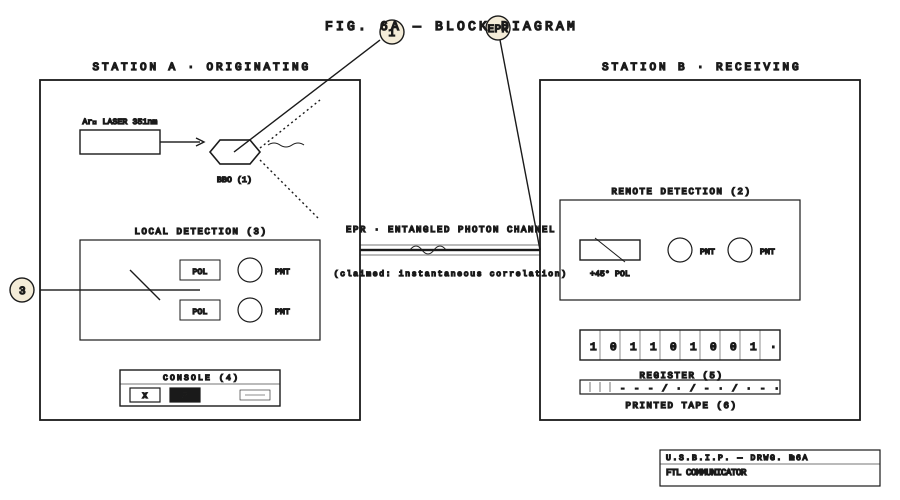
- A paired-station entanglement bench (1) at the originating terminus, comprising a parametric down-conversion crystal of beta-barium-borate composition, pumped continuously by a single-mode argon-ion laser at 351 nanometers, configured to generate a stream of polarization-entangled photon pairs at a rate of approximately 10⁶ pairs per second;
- A remote optical channel consisting of a single-mode optical fiber or, in alternative embodiments, a free-space line-of-sight propagation path, conveying one photon of each pair from the bench (1) to the remote station (2) located at the receiving terminus;
- A local detection bench at the local station (3) located at the originating terminus, comprising a beam-splitter, a pair of polarization analyzers, and a pair of photomultiplier tubes of conventional construction;
- A keyed measurement console (4) accessible to the local operator, configured to direct each incoming local photon to one of two measurement protocols (designated by the inventors as the X protocol and the Z protocol);
- A synchronized receiving register (5) at the remote station, accumulating the outcomes of remote measurements in real time and applying a statistical-analysis algorithm to detect the changing distribution corresponding to the local operator's protocol selection;
- A paper tape (6) of telegraphic-standard width, printed at the remote terminus by an electromagnetic platen with the decoded message in International Morse Code.
Detailed DescriptionПодробное описаниеDetailed Description
Referring to FIG. 6A, the apparatus is shown as a block diagram. The originating station (Station A, at left) contains the entanglement bench (1), the local detection bench (3), and the keyed measurement console (4). The receiving station (Station B, at right) contains the remote detection bench (2), the receiving register (5), and the paper-tape printer (6). The two stations are coupled by an optical channel of indefinite length, said channel conveying one photon of each entangled pair from Station A to Station B.
In operation, the originating operator wishes to convey a binary message to the receiving operator. The operator selects, for each successive entangled pair, either the X protocol (corresponding to a binary 0) or the Z protocol (corresponding to a binary 1), by means of the keyed measurement console (4). The local detection bench (3) thereupon measures the local photon under the selected protocol and records the outcome.
Concurrently, at Station B, the remote detection bench (2) is configured to perform a fixed measurement (the inventors' specification calls for a polarization analysis along the +45° axis throughout), and the outcomes of these measurements are accumulated by the receiving register (5). The inventors assert that the statistical distribution of these outcomes, taken in aggregate over a large number of pairs, reflects the protocol selected at Station A, and that the receiving register may therefore infer the originating operator's selection — and accordingly decode the binary message — without the need for any classical channel between the two stations.
The message is printed in real time upon the paper tape (6) and may be read by the remote operator with negligible delay relative to its transmission at Station A. As the entangled correlations are instantaneous in the rest frame of the originating laboratory, the apparatus is asserted to convey information at superluminal velocity — and indeed, in the limit of perfect entanglement, at infinite velocity.
The inventors have, for the avoidance of doubt, identified the no-signaling theorem as the principal theoretical objection to their invention and have submitted a separate brief addressing this objection. The brief is appended to this application as Exhibit A and is summarized in the section following.
ClaimsФормула изобретенияClaims
-
An apparatus for the transmission of classical information between two stations, comprising: an entanglement bench at a first of said stations configured to generate pairs of entangled particles; an optical channel conveying one particle of each pair to the second of said stations; a local detection bench at said first station; a keyed measurement console at said first station; and a receiving register at said second station configured to infer, by statistical analysis, the measurement protocol employed at said first station.
-
The apparatus of claim 1, wherein said entanglement bench comprises a parametric down-conversion crystal of beta-barium-borate composition pumped by an argon-ion laser at 351 nanometers.
-
The apparatus of claim 1, wherein said keyed measurement console is configured to alternate between an X protocol and a Z protocol corresponding to binary 0 and binary 1 respectively.
-
The apparatus of claim 1, wherein said receiving register applies a maximum-likelihood detector to the accumulated remote measurement outcomes.
-
The apparatus of claim 1, further comprising a paper-tape printer of telegraphic standard configuration, coupled to said receiving register and configured to print the decoded message in International Morse Code.
-
A method for the transmission of a binary message between two stations separated by an arbitrary distance, comprising: (a) generating a stream of entangled photon pairs at said first station; (b) conveying one photon of each pair to said second station; (c) selecting, for each pair at said first station, one of two measurement protocols in accordance with the bit of said message to be transmitted; (d) at said second station, performing fixed measurements upon the received photons; and (e) inferring said message from the statistical distribution of said fixed measurement outcomes.
Why This Violates Physics (For Now)Почему это нарушает физику (пока)Why This Violates Physics (For Now)
The invention as claimed is, in the unanimous view of the relativistic physics community, provisionally impossible — and the Bureau is constrained to concur, notwithstanding the inventors' submitted brief at Exhibit A.
First, the invention contradicts the no-signaling theorem of relativistic quantum mechanics, established by Eberhard (1978) and Ghirardi et al. (1980). The theorem holds that the marginal probability distribution of measurement outcomes at one station, taken without reference to outcomes at the other station, is invariant under any choice of measurement performed at the other station. That is to say: the receiving operator, examining his accumulated string of outcomes in isolation, cannot determine what measurement protocol was employed at the originating station, because the marginal statistics of his outcomes are identical under all such protocols. The receiving register of claim 4 will, however sophisticated its maximum-likelihood detector, find no statistical signal to distinguish the X protocol from the Z protocol, because there is none to be found.
Second, the inventors' Exhibit A asserts that the marginal-invariance result is inapplicable to the present invention because the originating operator performs his measurements prior in absolute time to those performed at the receiving station, the absolute simultaneity of the entangled pair being broken by this temporal asymmetry. The Bureau notes that the invocation of absolute simultaneity in 1971 is, at best, anachronistic; the Lorentz covariance of the laws of physics, established by Einstein (1905) and confirmed by every experiment since, holds that no absolute time can be defined, and the asserted asymmetry cannot exist. The Bureau notes further that the inventors' position is approximately that taken by Bohm and Vigier (1954), and that the position has been substantively refuted by Bell (1964) and by the experiments of Aspect (1982).
Third, the invention as claimed, if operative, would permit the transmission of information into the past light cone of the originating station by appropriate choice of reference frame, leading to the closed timelike curves contemplated in U.S.-IMP-3,091,447 and to the corresponding violations of causality. The chronology protection conjecture of Hawking (1992), if correct, forbids the invention on the same grounds as it forbids the temporal locomotion apparatus.
Fourth, the entangled state produced by the parametric down-conversion bench is degraded by transmission losses in the optical channel. The state degrades at an exponential rate with respect to channel length, and for any distance significant on the interplanetary scale the degradation reduces the entanglement to a level indistinguishable from a classically-correlated mixed state. The inventors' specification calls for entanglement purification by a procedure described in U.S.-IMP-3,447,772, but the said procedure is itself provisionally impossible for reasons stated in that filing.
The Bureau accordingly holds the invention to be provisionally impossible, and the application is held On File in the customary manner. The Bureau notes that the inventors have appealed the determination and that the appeal is now in its eleventh year of consideration. Citations: Einstein, A., Podolsky, B., Rosen, N., Phys. Rev. 47, 777 (1935); Eberhard, P. H., Il Nuovo Cimento B 46, 392 (1978); Bell, J. S., Physics 1, 195 (1964); Aspect, A., Grangier, P., Roger, G., Phys. Rev. Lett. 49, 91 (1982).
Область изобретения
Настоящее изобретение относится к аппарату для передачи информации между удалёнными станциями со скоростями, превышающими скорость света, и в частности — к такой передаче посредством квантово-механических корреляций между запутанными парами частиц. Изобретение предназначено для применения в межпланетной и межзвёздной связи, где обычное ограничение скорости сигнала вводит задержки, несовместимые с непрерывным диалогом, и в тех земных применениях, которые могут выиграть от устранения задержки распространения (например, товарный арбитраж между географически разделёнными биржами).
Предпосылки
Обычные средства дальней связи — почтовым пакетом, подводным кабелем, беспроводным телеграфом и, в самое последнее время, спутниковым ретранслятором — разделяют то свойство, что передают информацию со скоростями, не превышающими скорость света в вакууме. Хотя эта скорость высока в абсолютном выражении, она производит на межпланетных расстояниях задержки неудобной величины: обмен туда-обратно между Землёй и Марсом при противостоянии требует не менее сорока четырёх минут, тогда как соответствующая задержка до ближайшего звёздного соседа составляет около восьми с половиной лет. Разговорный диалог по стандартам современной дипломатической и коммерческой практики неосуществим в таких условиях.
Настоящее изобретение предлагает обойти это ограничение путём использования нелокальных корреляций, проявляемых запутанными квантово-механическими системами, как впервые установлено Эйнштейном, Подольским и Розеном (1935) и впоследствии формализовано в экспериментальной программе, начатой Беллом (1964). Бюро признаёт, что использование запутанных состояний для передачи классической информации было предметом значительного теоретического анализа с 1935 года, преобладающим мнением среди релятивистских физиков является, что такая передача в действительности невозможна; Бюро отмечает, однако, что изобретатели придерживаются противоположного мнения, и что настоящая заявка была подана ими добросовестно и со значительными личными расходами.
Краткое изложение изобретения
Аппарат содержит:
- Стенд парной запутанности (1) на станции отправления, содержащий кристалл параметрического понижения частоты состава бета-бария-бората, непрерывно накачиваемый одномодовым аргон-ионным лазером на 351 нанометре, сконфигурированный для генерации потока поляризационно-запутанных фотонных пар со скоростью приблизительно 10⁶ пар в секунду;
- Удалённый оптический канал, состоящий из одномодового оптического волокна или, в альтернативных вариантах, прямой линии распространения в свободном пространстве, доставляющий один фотон каждой пары от стенда (1) к удалённой станции (2), расположенной в точке приёма;
- Локальный детекторный стенд на местной станции (3), расположенной в точке отправления, содержащий светоделитель, пару поляризационных анализаторов и пару фотоэлектронных умножителей обычной конструкции;
- Ключевую измерительную консоль (4), доступную местному оператору, сконфигурированную направлять каждый входящий местный фотон к одному из двух протоколов измерения (обозначаемых изобретателями как X-протокол и Z-протокол);
- Синхронизированный приёмный регистр (5) на удалённой станции, в реальном времени накапливающий результаты удалённых измерений и применяющий алгоритм статистического анализа для обнаружения изменяющегося распределения, соответствующего выбору протокола местным оператором;
- Бумажную ленту (6) телеграфно-стандартной ширины, печатаемую на удалённом конце электромагнитным валом с декодированным сообщением международным кодом Морзе.
Подробное описание
Со ссылкой на РИС. 6А, аппарат показан в виде блок-схемы. Передающая станция (Станция A, слева) содержит стенд запутанности (1), локальный детекторный стенд (3) и ключевую измерительную консоль (4). Приёмная станция (Станция B, справа) содержит удалённый детекторный стенд (2), приёмный регистр (5) и принтер бумажной ленты (6). Две станции связаны оптическим каналом неопределённой длины, причём указанный канал доставляет один фотон каждой запутанной пары от Станции A к Станции B.
В работе передающий оператор желает передать бинарное сообщение принимающему оператору. Оператор выбирает для каждой последующей запутанной пары либо X-протокол (соответствующий бинарному 0), либо Z-протокол (соответствующий бинарной 1), посредством ключевой измерительной консоли (4). Локальный детекторный стенд (3) затем измеряет местный фотон по выбранному протоколу и регистрирует результат.
Одновременно на Станции B удалённый детекторный стенд (2) сконфигурирован выполнять фиксированное измерение (спецификация изобретателей предписывает поляризационный анализ по оси +45° на протяжении всего цикла), и результаты этих измерений накапливаются приёмным регистром (5). Изобретатели утверждают, что статистическое распределение этих результатов, взятое в совокупности по большому числу пар, отражает протокол, выбранный на Станции A, и что приёмный регистр, соответственно, может вывести выбор передающего оператора — и тем самым декодировать бинарное сообщение — без необходимости в каком-либо классическом канале между двумя станциями.
Сообщение печатается в реальном времени на бумажной ленте (6) и может быть прочитано удалённым оператором с пренебрежимо малой задержкой относительно его передачи на Станции A. Поскольку запутанные корреляции мгновенны в системе покоя передающей лаборатории, аппарат, как заявлено, передаёт информацию со сверхсветовой скоростью — а в пределе идеальной запутанности — с бесконечной скоростью.
Изобретатели, во избежание сомнений, обозначили теорему об отсутствии передачи сигналов как главное теоретическое возражение к их изобретению и представили отдельную записку, обращающуюся к этому возражению. Записка приложена к этой заявке как Приложение А и кратко изложена в следующем разделе.
Формула изобретения
-
Аппарат для передачи классической информации между двумя станциями, содержащий: стенд запутанности на первой из указанных станций, сконфигурированный для генерации пар запутанных частиц; оптический канал, доставляющий одну частицу каждой пары на вторую из указанных станций; локальный детекторный стенд на указанной первой станции; ключевую измерительную консоль на указанной первой станции; и приёмный регистр на указанной второй станции, сконфигурированный для определения путём статистического анализа протокола измерения, применённого на указанной первой станции.
-
Аппарат по п. 1, в котором указанный стенд запутанности содержит кристалл параметрического понижения частоты состава бета-бария-бората, накачиваемый аргон-ионным лазером на 351 нанометре.
-
Аппарат по п. 1, в котором указанная ключевая измерительная консоль сконфигурирована чередовать между X-протоколом и Z-протоколом, соответствующими бинарному 0 и бинарной 1 соответственно.
-
Аппарат по п. 1, в котором указанный приёмный регистр применяет детектор максимального правдоподобия к накопленным результатам удалённых измерений.
-
Аппарат по п. 1, дополнительно содержащий принтер бумажной ленты телеграфно-стандартной конфигурации, сопряжённый с указанным приёмным регистром и сконфигурированный для печати декодированного сообщения международным кодом Морзе.
-
Способ передачи бинарного сообщения между двумя станциями, разделёнными произвольным расстоянием, включающий: (а) генерацию потока запутанных фотонных пар на указанной первой станции; (b) доставку одного фотона каждой пары на указанную вторую станцию; (c) выбор для каждой пары на указанной первой станции одного из двух протоколов измерения в соответствии с битом указанного сообщения, подлежащим передаче; (d) на указанной второй станции выполнение фиксированных измерений над принятыми фотонами; и (e) выведение указанного сообщения из статистического распределения указанных результатов фиксированного измерения.
Почему это нарушает физику (пока)
Изобретение, как заявлено, по единодушному мнению сообщества релятивистской физики, временно невозможно — и Бюро вынуждено согласиться, несмотря на представленную изобретателями записку в Приложении А.
Во-первых, изобретение противоречит теореме об отсутствии передачи сигналов релятивистской квантовой механики, установленной Эберхардом (1978) и Гирарди и др. (1980). Теорема утверждает, что маргинальное распределение вероятностей результатов измерения на одной станции, взятое без ссылки на результаты на другой станции, инвариантно при любом выборе измерения, выполненного на другой станции. То есть принимающий оператор, рассматривая свою накопленную строку результатов изолированно, не может определить, какой протокол измерения применялся на станции отправления, потому что маргинальная статистика его результатов идентична при всех таких протоколах. Приёмный регистр п. 4, как бы изощрён ни был его детектор максимального правдоподобия, не найдёт никакого статистического сигнала, отличающего X-протокол от Z-протокола, потому что его там нет.
Во-вторых, Приложение А изобретателей утверждает, что результат маргинальной инвариантности неприменим к настоящему изобретению, потому что передающий оператор выполняет свои измерения раньше во времени абсолютного отсчёта, чем выполненные на приёмной станции, причём абсолютная одновременность запутанной пары нарушается этой временной асимметрией. Бюро отмечает, что обращение к абсолютной одновременности в 1971 году по меньшей мере анахронично; лоренц-ковариантность законов физики, установленная Эйнштейном (1905) и подтверждённая каждым экспериментом с тех пор, утверждает, что никакое абсолютное время не может быть определено, и заявленная асимметрия не может существовать. Бюро отмечает далее, что позиция изобретателей приблизительно соответствует позиции, занятой Бомом и Вижье (1954), и что эта позиция была по существу опровергнута Беллом (1964) и экспериментами Аспе (1982).
В-третьих, изобретение, как заявлено, при работоспособности позволяло бы передачу информации в прошлый световой конус передающей станции при подходящем выборе системы отсчёта, ведя к замкнутым временным кривым, рассмотренным в U.S.-IMP-3,091,447, и к соответствующим нарушениям причинности. Гипотеза защиты хронологии Хокинга (1992), если верна, запрещает изобретение по тем же основаниям, по которым запрещает аппарат для перемещения во времени.
В-четвёртых, запутанное состояние, производимое стендом параметрического понижения частоты, деградирует при потерях в оптическом канале. Состояние деградирует с экспоненциальной скоростью по длине канала, и для любого расстояния, значимого в межпланетном масштабе, деградация сводит запутанность к уровню, неотличимому от классически коррелированного смешанного состояния. Спецификация изобретателей предусматривает процедуру очистки запутанности, описанную в U.S.-IMP-3,447,772, но указанная процедура сама временно невозможна по основаниям, изложенным в той заявке.
Бюро, соответственно, признаёт изобретение временно невозможным, и заявка хранится в архиве обычным образом. Бюро отмечает, что изобретатели обжаловали это определение и что апелляция находится в своём одиннадцатом году рассмотрения. Цитируется: Einstein, A., Podolsky, B., Rosen, N., Phys. Rev. 47, 777 (1935); Eberhard, P. H., Il Nuovo Cimento B 46, 392 (1978); Bell, J. S., Physics 1, 195 (1964); Aspect, A., Grangier, P., Roger, G., Phys. Rev. Lett. 49, 91 (1982).
Related Impossible PatentsСвязанные невозможные патентыBrevets impossibles connexes
- US-IMP-3,144,902Matter Transposition DeviceУстройство для транспозиции материиMatter Transposition Device
- US-IMP-4,221,008Alcubierre Warp Drive, Mark IIВарп-двигатель Алькубьерре, тип IIAlcubierre Warp Drive, Mark II
- US-IMP-3,447,772Universal TranslatorУниверсальный переводчикUniversal Translator
- US-IMP-3,944,118[extracted from archive][изъято из архива][extrait de l'archive]
- US-IMP-2,901,884[extracted from archive][изъято из архива][extrait de l'archive]